Battery Chiller
Symptom Finder: What Is Actually Broken?
| What you see or hear | Part to check first |
|---|---|
| Charging rate tapering early with pack temperature climbing | Battery chiller or its expansion valve |
| Pack cooling ineffective while cabin cooling works | Battery chiller circuit |
| Coolant loss with no external leak found | Chiller internal leak between circuits |
| Refrigerant charge lost with a thermal fault stored | Battery chiller |
About Battery Chiller
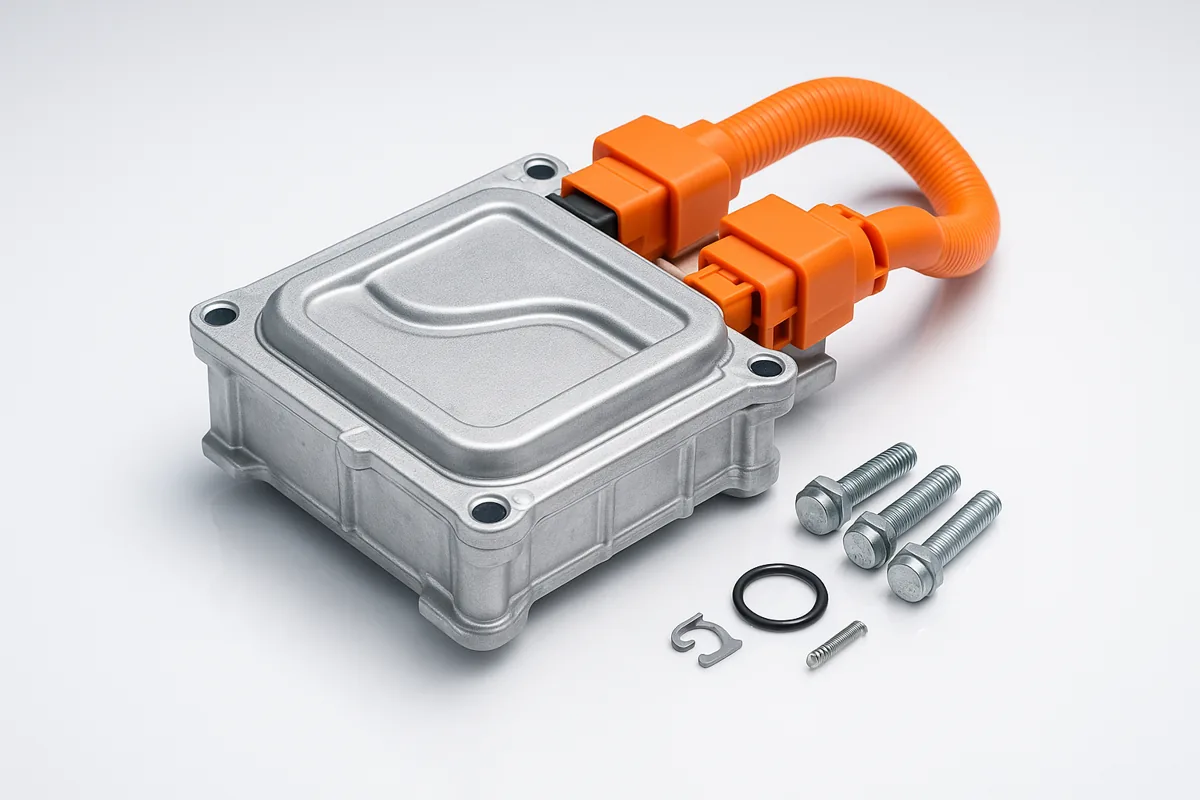
A traction pack has a narrow temperature band in which it performs well and ages slowly, and on a warm day or during rapid charging it produces heat faster than a radiator alone can remove. The chiller solves that by connecting the coolant loop serving the pack to the refrigerant circuit that runs the air conditioning. Refrigerant evaporating on one side of a compact plate exchanger absorbs heat from coolant flowing on the other, so the pack can be brought below ambient temperature rather than merely close to it. That capability is what allows sustained rapid charging in summer and what protects cell life over years. Control comes from an expansion valve metering refrigerant into the chiller only when the thermal system calls for it, so the same compressor serves cabin and pack in turn.
What to know before buying Battery Chiller parts
Send an enquiry with the OE number from the old part, or a photograph of the part and its label, and the thermal fault data. The catalogue is then checked directly for what is available.
Chiller content exists in the factory catalogue, and pricing is being brought online in stages. The component sits between two systems. Replacing one means opening both the refrigerant circuit and a coolant loop. That needs recovery equipment on one side and a documented bleed on the other, which makes it a workshop job rather than a driveway one.
Before You Order: 4 Checks
- Have both the refrigerant and coolant circuits diagnosed before pursuing a chiller.
- Confirm the workshop has recovery equipment matched to your refrigerant type.
- Plan for a documented coolant bleed after any work on the pack loop.
- Send an enquiry with your vehicle identification number and the thermal fault data.
What Changed and Why
Battery chilling has become standard on vehicles that support rapid charging, because charging speed is limited by how quickly heat can be removed from the cells rather than by what the charger can deliver. Heat pump systems have extended the same hardware, allowing waste heat from the pack and drive unit to be recovered into the cabin instead of rejected, which improves winter range. Electronic expansion valves have replaced mechanical metering so a single refrigerant circuit can serve cabin, pack and drive unit in whatever combination conditions require.
Battery Chiller: Frequently Asked Questions
What does a battery chiller actually do?
It lets the air conditioning system cool the traction pack. Coolant circulating through the pack passes through one side of a compact plate exchanger while refrigerant evaporates on the other, absorbing heat and carrying it away to the condenser at the front of the vehicle. Because refrigerant can be colder than ambient air, the chiller can bring the pack below outside temperature, which a radiator alone cannot do. That is what makes sustained rapid charging possible on a hot day and what protects cell life over the years.
Why is nothing priced in this category yet?
Because the listings are being brought online in stages and this hub is held open in the meantime rather than populated with partial information. The content exists in the factory catalogue, and an enquiry is checked directly against it. That is a more useful answer than a page implying availability that has not been confirmed. Coverage across the group grows as further catalogues load, so a reference unavailable today may well be listed shortly.
How do I know whether the chiller is the fault?
By the thermal data rather than the symptom, since a chiller fault, a stuck coolant valve and a failing pump all produce slow charging and reduced power. A workshop tool shows temperatures at each point in the loop along with commanded valve positions and refrigerant pressures, and the pattern usually identifies the component. A chiller that has failed internally can also allow coolant and refrigerant to mix, which shows as loss from both circuits with nothing on the ground.
Can I send an enquiry with nothing listed?
Yes, and it is the intended route. Send your vehicle identification number and the thermal fault data, and the factory catalogue is checked for what is available for your vehicle, with an indication of lead time. Because this component sits between the refrigerant and coolant circuits, it is also worth confirming that your workshop has recovery equipment matched to your refrigerant and can run the coolant bleed procedure before parts are ordered.