Busbars & Contactors
Symptom Finder: What Is Actually Broken?
| What you see or hear | Part to check first |
|---|---|
| Vehicle will not power up with a healthy low voltage supply | Main contactor |
| Clicking from the pack area with no drive available | Contactor failing to hold |
| Contactor welded fault reported | Contactor and its precharge circuit |
| Heat discolouration at a bolted high voltage joint | Busbar joint torque |
About Busbars & Contactors
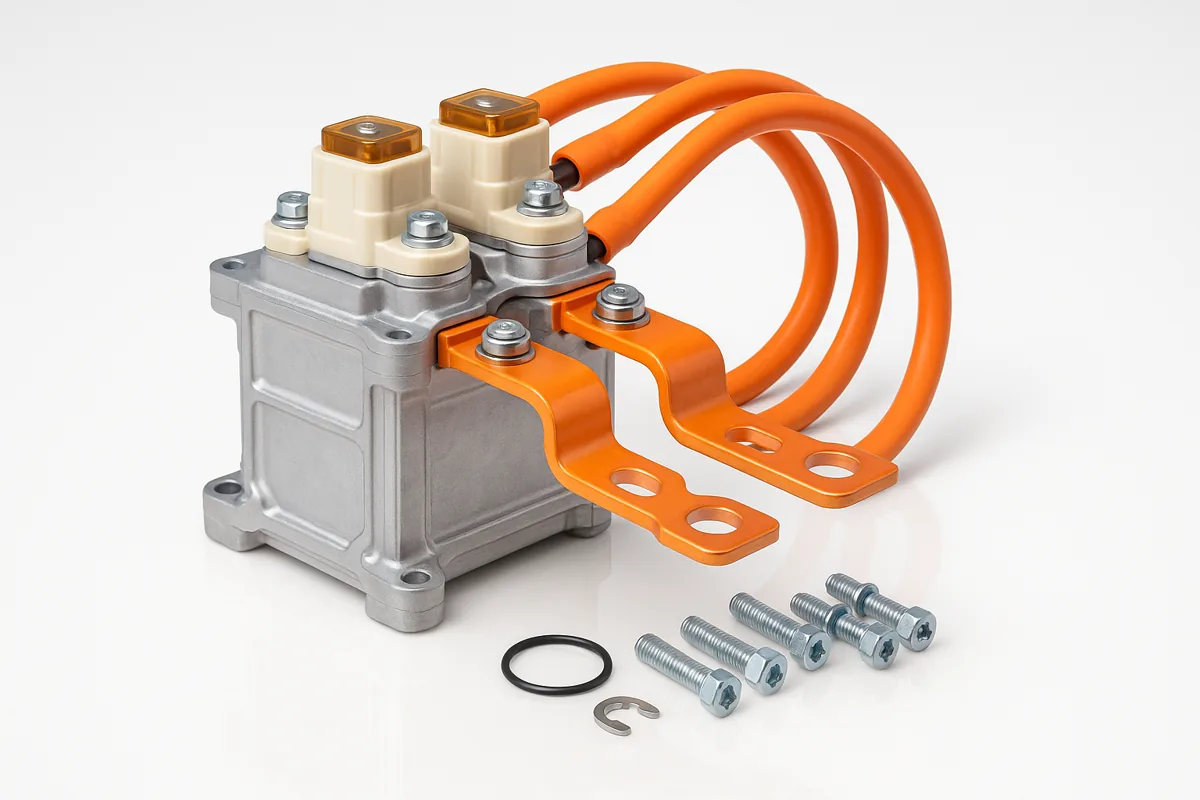
Where current is high and the run is short, cable gives way to solid conductor. A busbar is a rectangular bar of copper or aluminium bolted at each end, used inside packs to link cell groups and outside them to connect a pack to a distribution unit or an inverter, and it handles heat better than an equivalent cable while occupying less space. Torque at the bolted joints is the whole story of reliability, since a joint that is loose develops resistance, resistance develops heat, and heat loosens the joint further. Contactors are the switches in that path: heavy duty relays whose contacts are closed by a coil so the pack can be connected when the vehicle is ready and isolated the instant it is not. They are commanded by the management system and monitored for welding.
What to know before buying Busbars & Contactors parts
Busbar and contactor content exists in the factory catalogue. Pricing is being brought online in stages.
Everything here sits on the high voltage path. Isolate the system and verify zero voltage before any work. Bolted joints are torque critical rather than merely tight.
Contactor faults often trace to the low voltage supply that holds the coils closed. Exclude that before you order a contactor. Send an enquiry with the OE number from the old part. A photograph of the part and its label also works. Include the stored codes and we will check the catalogue for what is available.
Before You Order: 4 Checks
- Test the low voltage supply first, since contactor coils depend on it.
- Have the stored codes read with high voltage diagnostic access before ordering.
- Treat every bolted joint as torque critical and follow the specified figure.
- Send an enquiry with your vehicle identification number and the fault data.
What Changed and Why
Solid state protection and switching devices are beginning to appear alongside electromechanical contactors, offering far faster fault interruption and the ability to reset without replacement, though relays remain the norm in production. Higher pack voltages have raised the difficulty of interrupting direct current faults, which places more weight on precharge working correctly so contactors never close into a large inrush. Busbar design has followed integration, with several formerly separate connections disappearing as motor, inverter and gearing move into one housing.
Busbars & Contactors: Frequently Asked Questions
Why does a contactor weld shut?
Because it closed into a current it was not designed to make. The inverter contains large capacitors, and connecting a pack straight onto them draws an inrush that can fuse the contact surfaces together, which is exactly why a precharge circuit exists to bring the voltage up gently first. When precharge fails and the main contactor closes anyway, welding is the likely outcome. A welded contactor is serious, since the pack can no longer be disconnected, and vehicles detect and report it.
My car will not power up. Is a contactor at fault?
Possibly, and check the low voltage supply first because it is a far more common cause. Contactor coils are held closed by the twelve volt circuit and the controllers that command them run on it, so a weak auxiliary battery produces a vehicle that will not connect its pack while every high voltage component is perfectly healthy. If the supply is good and the vehicle still refuses, the codes will distinguish a contactor fault from a precharge or interlock problem.
Why is nothing priced in this category yet?
These sit directly on the high voltage path, and supplying them carries obligations beyond handing over a part: isolation procedure, torque values and the inspection that follows. Publishing prices ahead of confirming those details would be careless with something that can injure someone. So the page describes the components and routes requests to people who can answer them properly. An enquiry returns the reference for your vehicle together with the fitting requirements, and where the busbar or contactor is only available as part of a larger assembly, the reply says so plainly.
Can I inspect any of this myself?
Visually and no further. Look for damaged orange cabling, corrosion, missing brackets or heat discolouration around bolted joints, all of which are useful findings. Anything involving removal, or opening a housing that contains busbars, requires isolation, verified zero voltage and correct equipment, because these conductors sit at pack potential and the energy behind them cannot be switched off in the ordinary sense. Report what you see and let a qualified workshop take it from there.