DC/DC Converter
Symptom Finder: What Is Actually Broken?
| What you see or hear | Part to check first |
|---|---|
| Auxiliary battery repeatedly flat with a healthy battery fitted | DC-DC converter |
| Low voltage warning while driving | DC-DC converter output |
| Multiple unrelated faults appearing together | Low voltage supply from the converter |
| Vehicle will not wake with the traction pack healthy | Auxiliary battery or converter |
About DC/DC Converter
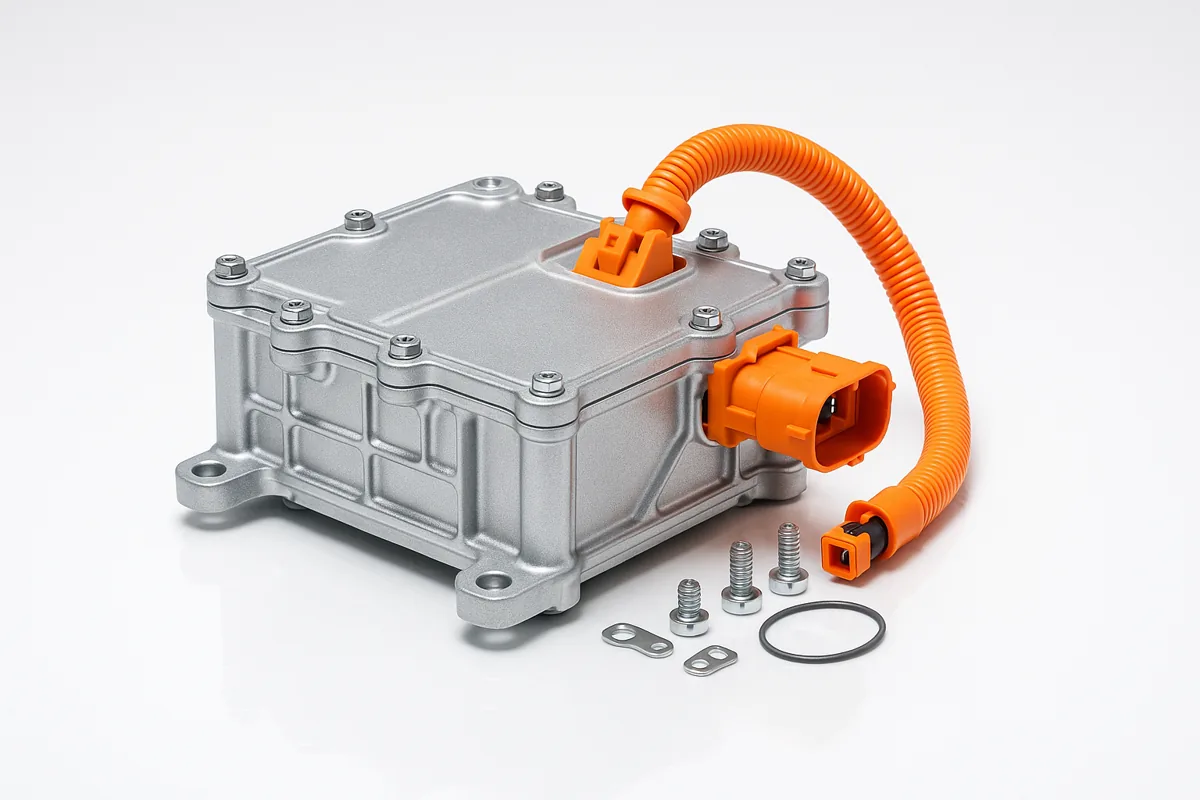
An electric vehicle still needs a low voltage supply, because lighting, control units, motors for wipers and windows, and the contactors that connect the pack all run on it. With no engine to turn an alternator, that supply comes from the traction pack through a converter, which steps several hundred volts down to the level the vehicle's ordinary systems expect and regulates it precisely as loads change. It also charges the auxiliary battery, taking the place of both alternator and regulator. That makes it a component whose failure is felt everywhere at once: the auxiliary battery is left to run the vehicle alone, it flattens within hours, and what the driver sees is a car that will not wake rather than an obvious converter warning.
What to know before buying DC/DC Converter parts
Rule out the auxiliary battery first. A tired battery and a failed converter present almost identically.
On many vehicles the converter is combined with the charger and the distribution unit in one module rather than supplied on its own. It carries high voltage, so the system must be isolated before any work. Replacement usually involves coding.
Converter content sits in the factory catalogue and pricing is coming online in stages. Send an enquiry with the stored codes and either the OE number from the old part or a photograph of the part and its label, and we will check the catalogue directly.
Before You Order: 4 Checks
- Test the auxiliary battery under load first, since it produces identical symptoms.
- Measure the low voltage system voltage with the vehicle awake to confirm the converter is supplying.
- Establish whether your vehicle uses a separate converter or a combined module.
- Send an enquiry with your vehicle identification number and the fault data.
What Changed and Why
Integration is the defining trend. On more and more vehicles the converter shares a housing with the on board charger and the distribution unit, which removes high voltage connections and saves weight while meaning a single failure is diagnosed and replaced at module level. Bidirectional capability is spreading alongside, allowing the same hardware to support export functions. Higher pack voltages have raised the conversion ratio the unit must handle, which has pushed newer semiconductor devices into this application for the same efficiency reasons that drove them into traction inverters.
DC/DC Converter: Frequently Asked Questions
What does the converter do that an alternator used to?
Exactly the same job by different means. It supplies the vehicle's low voltage system and keeps the auxiliary battery charged, drawing from the traction pack rather than from a belt driven generator, and regulating its output precisely as loads switch on and off. Because there is no engine, it can do this whenever the vehicle is awake or charging rather than only when running. When it fails, the auxiliary battery is left supporting the whole vehicle and flattens quickly.
How do I tell a converter fault from a flat auxiliary battery?
Measure while the vehicle is awake. With the vehicle in its ready state, the low voltage system should sit noticeably above the battery's resting voltage, which shows the converter is supplying and charging. If it sits at battery voltage or falls under load, the converter is not delivering. Test the battery separately under load as well, since a battery that will no longer hold charge produces the same daily symptoms while the converter works perfectly.
Why is nothing priced in this category yet?
Because on a great many vehicles the converter is not a separate item at all. It is built into a combined module alongside the charger and the distribution gear, and putting a standalone reference on the page would suggest a repair route your car may not have. Rather than publish something misleading, this hub explains the component and takes enquiries. Send your vehicle identification number and the request is checked against the factory data for your build, which settles whether a loose converter exists for it or whether the module is the service part.
Can I send an enquiry with nothing listed?
Yes, and it is the right route. Send your vehicle identification number and the stored codes, and the catalogue is checked for what is available, including whether your vehicle takes a discrete converter or a combined module. Confirm at the same time that your workshop has the diagnostic access to code the replacement, since these units arrive without configuration and an uncoded module leaves the vehicle without a low voltage supply.