Motor Position Sensor (Resolver)
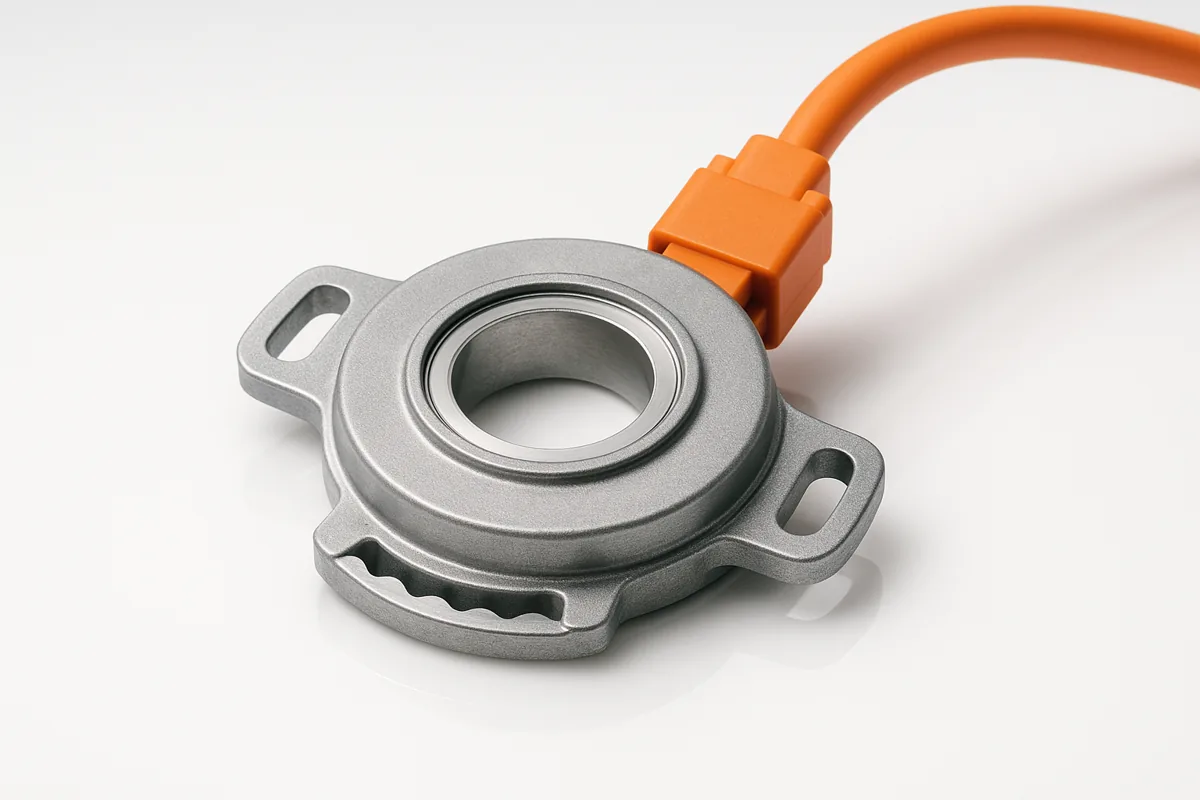
Symptom Finder: What Is Actually Broken?
| What you see or hear | Part to check first |
|---|---|
| Drive system fault with reduced or no torque | Motor position sensor or its wiring |
| Rough or uneven torque delivery | Resolver offset out of calibration |
| Fault appearing after drive unit or inverter work | Position offset not relearned |
| Intermittent drive fault that changes with temperature | Resolver signal wiring or connector |
About Motor Position Sensor (Resolver)
A permanent magnet motor cannot be driven blind. The inverter must know precisely where the rotor sits at every instant so it can energise the windings at the right moment, and a few degrees of error costs torque, wastes energy as heat and in the worst case makes the machine behave unpredictably. A resolver provides that information: a rotating transformer with an excitation winding and two output windings arranged so their signals vary with angle, producing a reading that shrugs off heat, vibration and electrical noise in a way that many alternatives cannot. Its alignment to the rotor is not arbitrary, which is why an offset value is learned and stored, and why disturbing the sensor or fitting a new drive unit requires that value to be established again.
What to know before buying Motor Position Sensor (Resolver) parts
Send an enquiry with the stored fault codes and the OE number from the old part, or a photograph of the part and its label. Resolver content sits in the factory catalogue, and pricing is coming online in stages. We check the catalogue directly for what is available.
The sensor is usually built into the drive unit rather than sold loose. A fault here often turns into drive unit level work. Any replacement needs the position offset relearned with the correct tooling. The part sits next to high voltage, so isolation applies.
Before You Order: 4 Checks
- Have the stored codes read with high voltage diagnostic access before pursuing the sensor.
- Check the signal wiring and connector, since shielded signal faults mimic sensor failure.
- Confirm whether the sensor is supplied separately or as part of the drive unit.
- Send an enquiry with your vehicle identification number and the fault data.
What Changed and Why
Position sensing is where cost and robustness pull against each other. Resolvers remain common because they tolerate heat, vibration and electrical noise well, while inductive and magnetic sensors are spreading as cheaper alternatives with electronics that compensate for their sensitivity. Integration is the stronger trend: as motor, inverter and gearing move into one housing, the position sensor becomes an internal component diagnosed and supplied at unit level, and the offset learning procedure becomes part of commissioning the assembly rather than a standalone adjustment.
Motor Position Sensor (Resolver): Frequently Asked Questions
What does the resolver do?
It tells the inverter exactly where the rotor is at every instant, which is what allows the windings to be energised at the correct moment to produce torque efficiently. A permanent magnet machine driven with an incorrect angle produces less torque, wastes the difference as heat and can behave unpredictably, so the sensor is not a monitoring device but a control input. That is also why its alignment to the rotor is learned and stored rather than assumed, and why the stored value matters as much as the hardware.
Why is nothing priced in this category yet?
On most vehicles built today the resolver lives inside the drive unit and is not offered loose, so a price against it would imply a repair that cannot actually be carried out at component level. That is the honest reason the field is empty. The hub remains here so the sensor and its role can be described, and so anyone chasing a position signal fault has somewhere to ask. Enquiries are matched against the manufacturer data for your specific vehicle, which will show whether the sensor is serviceable separately or only with the drive unit.
My drive fault appeared after other work. Could this be why?
Very possibly. If the drive unit or the inverter has been disturbed, the stored position offset may no longer match reality, and the symptom is reduced or absent torque with a drive system fault rather than anything mechanical. The offset is relearned with the correct tooling as part of commissioning the assembly. Confirm with the workshop that the procedure was carried out, since it is easily overlooked and the fault it produces looks like a hardware failure.
Can I send an enquiry with nothing listed?
Yes. Send your vehicle identification number and the stored codes, and the catalogue is checked for whether the sensor is available separately for your vehicle or supplied as part of the drive unit. It is also worth confirming that your workshop can perform the offset relearn, since without it a replacement cannot be commissioned and the vehicle will not drive correctly whatever hardware is fitted.