BYD e5 Parts
Shop BYD e5 Parts by Category
Popular for the BYD e5
scroll for more →
Symptom Finder: Known Weak Points
| What you see or hear | Check first |
|---|---|
| Car will not power up and several warnings appear at once | Check the 12 V battery and its terminals before suspecting the traction battery. Order the replacement by the OE number on the old battery, since it may be a lithium unit rather than lead-acid. |
| Knocking from the front over bumps | Inspect the MacPherson strut top mounts, anti-roll bar links and lower arm bushes. Taxi mileage wears these early. Order by side and OE number. |
| Brake judder, grinding or a pulsing pedal | Check the pads and discs on both axles. Regenerative braking means the friction brakes are used less, so rear discs can corrode. Order discs and pads as a set per axle. |
| Charging will not start or stops early | Inspect the charging socket at the front of the car for bent or burnt pins, debris and damage to the charge door. Then order the socket or door parts by OE number. |
| Weak heating, poor demisting or noisy fan | Check the blower motor, its resistor or control module and the cabin filter first. Fleet cars run climate hardware for long shifts. Match the part by OE number. |
| Motor position or drive system fault warning | Read the fault code, then inspect the resolver connector and wiring before the sensor itself. Confirm whether the motor is the 160 kW or 100 kW unit before ordering. |
| Uneven or rapid tyre wear on the rear axle | Check the multi-link rear bushes and arms for wear, then have the alignment set after replacing them. Order bushes by side and OE number. |
Most Replaced Parts on the e5
- Door skins, hinges and check strapsTaxi work opens and shuts the doors far more often than private use
- Shock absorbers and strutsMany e5s worked as taxis, so dampers often wear before the mileage suggests
- Body fasteners, clips and adhesivesClips and trim fixings break easily when panels come off for repair
- Evaporator, blower and heater core partsClimate hardware on a fleet car often runs for a whole shift
- 12 V feeds, earth points and connectorsLow-voltage faults can stop the car powering up, so check feeds first
About BYD e5 Parts
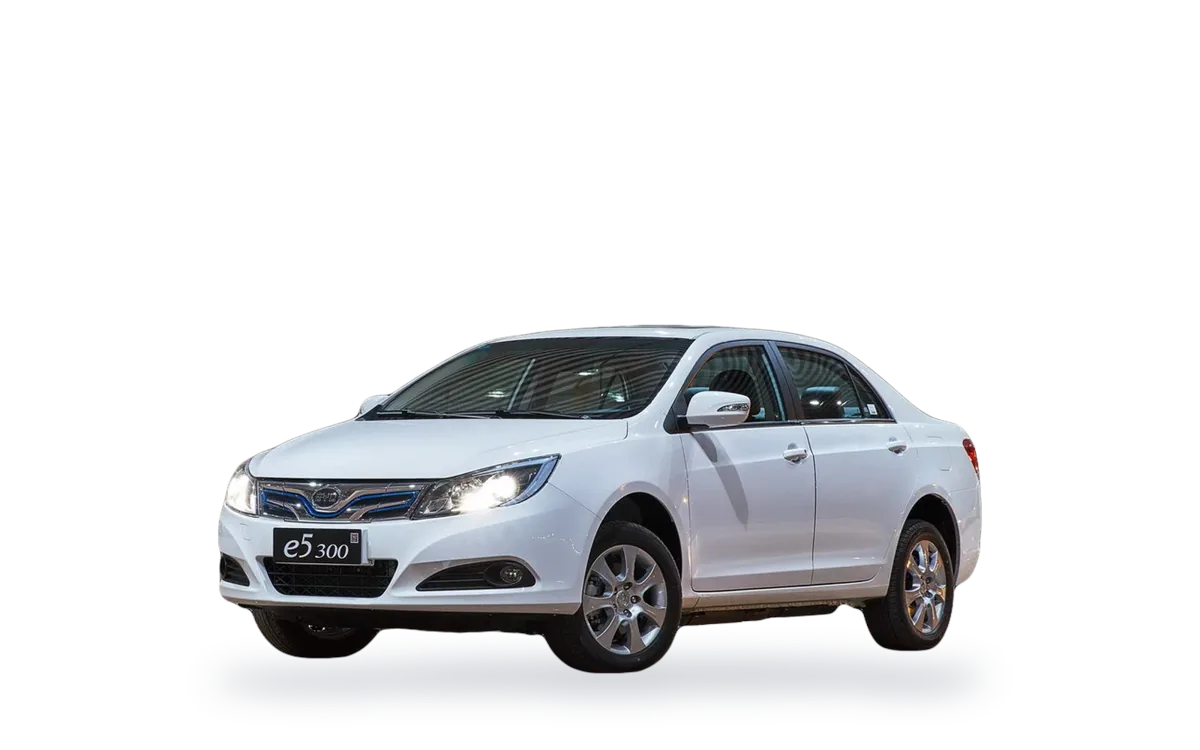
The BYD e5 is a compact electric saloon developed from the petrol BYD Surui. It went on sale in China in September 2015, was built until 2020 and was widely used as a taxi and ride-hailing car. A single permanent-magnet motor drives the front wheels. It is rated at 160 kW on retail cars and 100 kW on the fleet versions listed from the 2018 model year. The body stayed the same throughout, at 4,680 mm long on a 2,660 mm wheelbase, but the battery changed. Early cars used lithium iron phosphate cells, and the e5 450 of March 2018 moved to a ternary lithium pack of about 60.5 kWh. For parts, this means body, suspension and brake hardware carries across most of the run, while battery, charging and motor parts depend on the version. Every part on this page is listed by its OE number, and that number is the surest way to confirm a part fits.
What to know before buying BYD e5 parts
Start by confirming which e5 you have. Every version shares the same saloon body, 4,680 mm long, 1,765 mm wide and 1,500 mm high on a 2,660 mm wheelbase, so the shape will not tell you which battery or motor is fitted. The badge helps. The e5 300 of 2016 and 2017 used lithium iron phosphate cells, and the e5 450, launched in March 2018, carries a ternary lithium pack of about 60.5 kWh. The fleet versions, sold as travel and taxi editions from the 2018 model year and as a rental and travel edition from April 2020, use a smaller 51.2 kWh pack. Badges can be removed or swapped, so read the build date on the identification plate and match the OE number on the old part before ordering anything for the battery or its management.
The motor splits the same way. Retail e5 450 cars use a 160 kW motor with 310 Nm, while the fleet versions use a 100 kW motor with 180 Nm. Order motor, controller and reduction gear parts by the OE number on the unit fitted, never by the model name alone. Equipment varied as well. Fleet versions were built with less standard equipment than the retail trims, so airbags, lamps and cabin electronics can differ between two cars of the same year. Match those parts to the car in front of you rather than to a brochure.
The running gear is where parts carry across. The versions in our sources all use MacPherson struts at the front, a multi-link rear axle, ventilated front discs with disc brakes at the rear, and 205/55 R16 tyres. Because many e5s worked as taxis, bushes, dampers and brakes often wear faster than the mileage of a private car would suggest, so when one side of an axle is worn, check the other side too.
The e5 was developed from the BYD Surui and keeps its basic shell, and it overlaps in electric hardware with the Qin EV range. A part that looks shared is not always the same part, so treat a Surui or Qin EV listing as a lead and confirm it by OE number. Surui body diagrams show a fuel filler flap on the rear wing, which the e5 does not use, since its charging sockets sit at the front of the car. For painted panels, order by the colour code on the car rather than by the colour name.
Before You Order: 7 Checks
- Read the badge and the build date on the identification plate, then match battery, battery management and charging parts to the correct side of the March 2018 change from the e5 300 to the e5 450.
- Check whether the car is a retail e5 or a 100 kW fleet version, then order motor, controller or reduction gear parts by the OE number on the unit.
- Match the OE number on the part you are replacing to the OE number on the listing before you order.
- Treat Surui and Qin EV parts as possible matches only, and confirm each one by OE number before ordering.
- Read the tyre size on the sidewall, normally 205/55 R16, before ordering tyres or wheels.
- Order painted panels by the colour code on the car rather than by colour name.
- On a former taxi, inspect bushes, dampers and brakes on both sides of the axle, and order in pairs where both sides are worn.
Generations and Facelifts
The e5 grew out of the BYD Surui, a petrol compact saloon launched in 2012. BYD kept the Surui's body and replaced the engine with a single electric motor driving the front wheels. Retail sales of the e5 began in China in September 2015, with a lithium iron phosphate battery and a quoted range of 220 km.
The e5 300 followed in 2016. It shared much of its electric hardware with the Qin EV300 of the same period and kept the lithium iron phosphate chemistry and the 160 kW motor.
The biggest change came in March 2018 with the e5 450. It moved to a ternary lithium pack of about 60.5 kWh, raising the quoted range to about 400 km, and kept a 160 kW, 310 Nm motor. The body, tyre size and suspension layout did not change, so this split matters for battery, battery management and charging parts rather than panels. Read the build date on the identification plate before ordering any of those.
Fleet versions were also listed for the 2018 model year, sold as travel and taxi editions, with a 100 kW, 180 Nm motor and a 51.2 kWh pack giving about 405 km on the NEDC cycle. A rental and travel edition continued this specification from April 2020. Of all the versions, these fleet cars are the most likely to differ from a retail car of similar age in their motor and electrical parts.
None of the sources consulted shows a facelift reaching buyers. The e5 kept the same body and dimensions from launch until production ended in 2020, when the Qin EV took its place in BYD's range. There is no dated break in bumpers, grilles or lamps to order against.
BYD e5 Parts: Frequently Asked Questions
How do I make sure a part fits my BYD e5?
Match the OE number. Every part on this site is listed under the OE number printed on the original part. If the number on the part you are replacing matches the listing, the part fits. This check matters on the e5 because the body stayed the same from 2015 to 2020 while the battery and motor changed underneath it, so two cars that look identical can need different parts. If the old part is missing or its number cannot be read, send a photo through the quote form and we will reply within 24 hours, usually sooner.
What is the difference between the e5 300 and the e5 450?
The main difference is the battery. The e5 300 of 2016 used lithium iron phosphate cells. The e5 450, launched in March 2018, moved to a ternary lithium pack of about 60.5 kWh with a quoted range of about 400 km. Retail versions of both use a 160 kW motor, and the body is the same. Battery, battery management and charging parts do not cross between the two, so read the build date on the identification plate and match those parts by OE number.
Will an e5 450 battery module fit an earlier e5?
No. The earlier cars use lithium iron phosphate cells and the e5 450 uses ternary lithium cells, each with battery management to suit its chemistry. Modules, cell monitoring parts, contactors and the pack itself must match the chemistry the car was built with, and the badge on the boot lid is not enough, since badges are sometimes changed. Read the build date on the identification plate, check the OE number on the old part, and order the part that carries the same number.
What is the rental and travel edition, and does it use different parts?
It is a fleet version for rental and ride-hailing work, reported from April 2020. It carried on the specification of the 2018-model travel and taxi editions, with a 100 kW motor and 180 Nm, against 160 kW on retail cars, and a 51.2 kWh battery with about 405 km of NEDC range. The body, the 205/55 R16 tyres and the suspension layout follow the retail car, but the motor, controller and battery parts are specific to the fleet versions, and some equipment differs from the retail trims. Check the output on the motor plate or the OE number on the old part before ordering drive or battery parts.
Do BYD Surui parts fit the e5?
Some do. The e5 was developed from the petrol Surui and keeps its basic saloon shell, so some body parts, glass and trim may share part numbers. The Surui's engine, fuel system and exhaust parts have no place on the e5, and Surui body diagrams show a fuel filler flap that the e5 does not use. Treat a Surui listing as a lead rather than a confirmed match, and check each part against the OE number on the old part before ordering.
Are e5 parts shared with the BYD Qin EV?
Some are. The e5 300 shared much of its electric hardware with the Qin EV300 of the same period, and the Qin EV later replaced the e5 in BYD's range. The two cars have different bodies, so panels, lamps, glass and most trim will not cross over. Electric drive and battery parts may share numbers, but never assume they do. Compare the OE number on your old part with the one on the listing before ordering, and send it through the quote form if you are unsure.
Where is the charging socket on the e5?
It is at the front of the car, behind the BYD badge in the grille, and not in a rear wing flap as on the petrol Surui. Because the sockets sit in the nose, a minor front-end knock can damage the charge door, its release or the socket housing as well as the bumper and grille. After any front-end repair, check that the charge door opens and closes properly. Then order the socket, door or release parts by the OE number on the old parts.
Can I fit an ordinary lead-acid 12 V battery?
Match the 12 V battery by OE number rather than by size alone. Many BYD cars of this period use a lithium iron phosphate 12 V battery with its own management electronics, and a lead-acid unit may not suit the car's charging and monitoring. A weak 12 V battery can stop the car powering up altogether, sometimes with warnings from several systems at once, and that can look like a traction battery fault. Check the 12 V battery first, then order the replacement that carries the old unit's number.
What tyre size does the e5 use?
The e5 is listed on 205/55 R16 tyres, on retail cars and on the 2020 rental and travel edition alike. The size did not change when the e5 450 arrived. Wheels and tyres may have been changed during a car's life, especially on a former taxi, so read the size on the sidewall of the tyres fitted before you order. Match rims to the same size, and order wheel bolts or trims by the OE number on the old parts.
Did the e5 have a facelift?
None of the sources we checked shows a facelift reaching buyers. The e5 kept the same body, 4,680 mm long on a 2,660 mm wheelbase, from its launch in September 2015 until production ended in 2020. The changes that matter for parts were underneath: the battery in March 2018 and the 100 kW fleet versions from the 2018 model year. There is no split between earlier and later bumpers, grilles or lamps to check for, so order those by OE number and painted panels by the colour code.
Why do suspension and brake parts wear quickly on some e5s?
Many e5s were bought for taxi and ride-hailing work, where a car covers high daily mileage with frequent stops while carrying a heavy battery. That combination works the MacPherson front struts, the multi-link rear axle, the bushes and the brakes hard. When one damper or bush has worn, check the same part on the other side of the axle. Then order in pairs by OE number so that the car handles evenly after the repair.
My e5 shows a motor position or drive system fault. What should I check?
Read the fault code with a scan tool before ordering anything. On a single-motor car like the e5, a position fault usually points to the resolver, the sensor that tells the controller where the rotor is, or to its wiring and connector, rather than to the motor itself. Inspect the connector for corrosion or damage first. Then confirm whether the car has the 160 kW or the 100 kW motor, and order by the OE number on the old part.