BYD F6 Parts
Shop BYD F6 Parts by Category
Popular for the BYD F6
scroll for more →
Symptom Finder: Known Weak Points
| What you see or hear | Check first |
|---|---|
| Stalling from rest or an unsteady idle | Start with the throttle body and idle control, then the fuel filter. Clean or replace them, and match any sensor by the OE number for the engine fitted. |
| Oil seeping from the top of the engine | The rocker cover gasket and the oil filler cap. The Mitsubishi 2.4 and the BYD 483 engines use different covers and gaskets, so order by engine code. |
| Whining, ticking or belt noise from the front of the engine | The timing belt, tensioner and auxiliary belt. On a car this age, find out when the timing belt was last changed, then order the kit for the engine code. |
| Judder, slip or flaring revs when pulling away in a two-pedal 2.0 | This is likely to be the CVT. Check the fluid level and condition first, topping up only with the correct CVT fluid, before ordering gearbox parts by OE number. |
| Brake judder or a pulsing pedal | The discs and pads, front and rear. Order by axle, and check the caliper slides at the same time. |
| Knocking over bumps or loose-feeling steering | The control arm bushes, anti-roll bar links and strut top mounts. Rubber ages with time, so inspect both sides and order by OE number. |
| Rust at the lower door edges or sills | The door and sill drain holes. Clear them and check the panel before ordering, and order painted parts by the colour code. |
Most Replaced Parts on the F6
- Valvetrain and camshaft partsSplit between the single-cam Mitsubishi 2.4 and the BYD 483 engines, so order by engine code
- Pistons, rings and bearingsEngine internals differ between the BYD 483 family and the Mitsubishi 4G69
- Coolant hoses, tanks and sensorsHoses and sensors differ by engine, so match each one by OE number
- Control arms and bushingsRubber bushes on a saloon now well into its second decade
- Shock absorbers and strutsThe body never changed size, so order front and rear dampers by OE number
About BYD F6 Parts
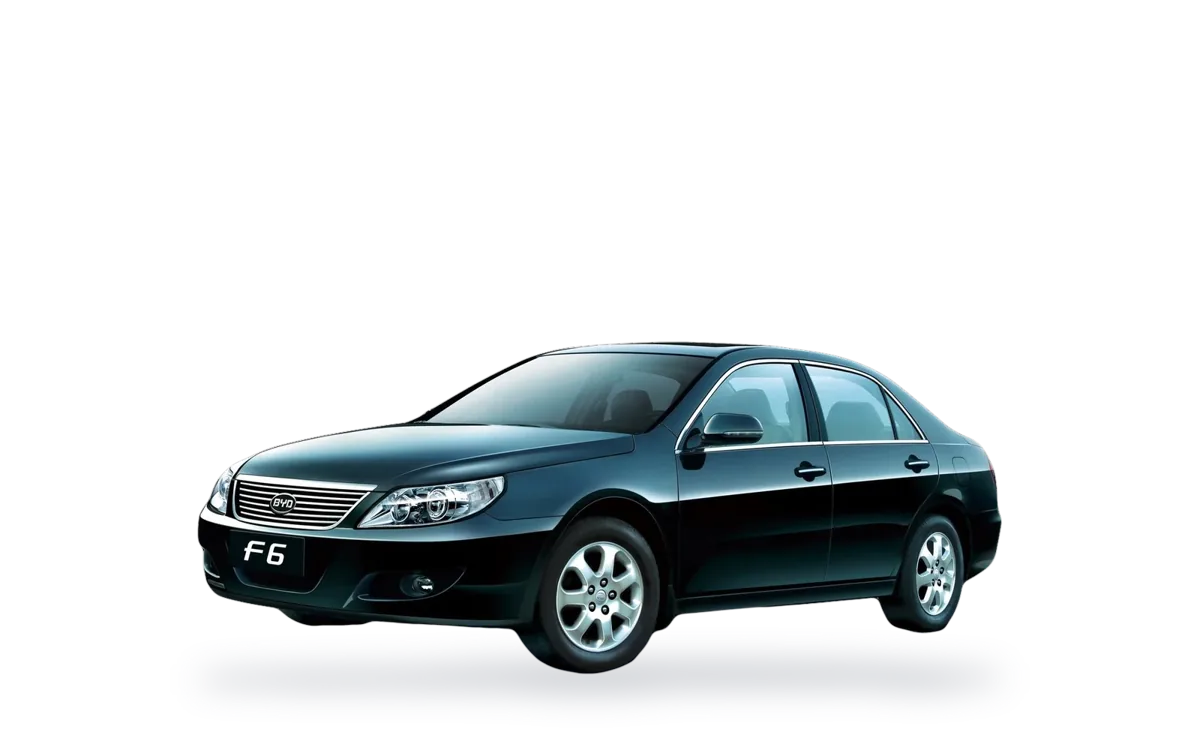
The BYD F6 is a five-seat, front-wheel-drive mid-size saloon. BYD built it from 2008 to 2012, when the BYD G6 replaced it. Every F6 has a petrol engine driving the front wheels, but three different engines were fitted: BYD's own 2.0 litre 483QB, BYD's 1.8 litre 483QA and a 2.4 litre Mitsubishi 4G69. Depending on the engine and model year, the gearbox is a five-speed manual, a four-speed automatic or a CVT. The body kept the same dimensions throughout, 4,846 mm long and 1,822 mm wide on a 2,740 mm wheelbase, and we found no record of a body facelift. That makes panels and glass the easier part of this car to order for. Engine, gearbox and fluid parts are where wrong orders happen. Every part on this page is listed by its OE number, and matching the number on the old part is the surest check that a replacement fits.
What to know before buying BYD F6 parts
Start with the engine, since the badge on the boot is a poor guide on a car of this age. The 2.0 and the 1.8 are BYD engines from the same 483 family, the 483QB and the 483QA. The 2.4 is a Mitsubishi 4G69, a single-cam engine with Mitsubishi's MIVEC variable valve timing, and it shares very little with the BYD pair. Filters, spark plugs, gaskets, the timing belt kit, sensors and engine mounts all have to be ordered for the engine actually fitted. Read the engine code stamped on the block, or the OE number on the part you are removing, before you order.
The gearbox depends on the engine and the model year. The first cars in 2008 came as a 2.0 with a five-speed manual or a 2.4 with a four-speed automatic. The Golden Edition range of 2010 added a 1.8 manual and a 2.0 with a CVT, and by the 2011 model year only the 1.8 manual and the 2.0 CVT were listed. A 2.0 can therefore be a manual or a CVT, and the two share no clutch, fluid or gearbox parts. A clutch pedal tells you it is a manual. On a two-pedal car, confirm whether it is the CVT or the four-speed automatic before ordering fluid, filters or mounts.
The G6 replaced the F6 in September 2011 and carries the same 2.0 483QB engine, so some 2.0 engine parts cross between the two. The body does not. The G6 is 4,860 mm long on a 2,745 mm wheelbase, against 4,846 mm and 2,740 mm for the F6, and it had its own gearboxes, a five-speed manual or a six-speed dual-clutch. Treat G6 panels, glass, trim and gearbox parts as parts for a different car. The M6 people carrier of the same period also used the 2.0 483QB and the Mitsubishi 4G69, but some M6 cars had BYD's own 2.4 488QA instead, so an M6 2.4 part may or may not suit an F6. Match engine parts by OE number rather than by car name.
Equipment varied by trim. Press material for the 2009 New Fortune Edition lists ABS with EBD, disc brakes front and rear and dual airbags. Check what is fitted to the car in front of you before ordering parts that depend on trim. Read the tyre size on the sidewall rather than assuming a size by trim, and order painted panels by the colour code on the car.
Where a part changed during the run, such as gearbox and trim parts that came in with a new edition, read the build date on the identification plate and match the part by OE number. The section on generations and facelifts below sets out when each version arrived.
Before You Order: 7 Checks
- Read the engine code on the block or the OE number on the old part, then order engine parts for the 2.0 483QB, the 1.8 483QA or the 2.4 Mitsubishi 4G69 as fitted.
- Check for a clutch pedal before ordering gearbox parts or fluid, since a 2.0 may be a manual or a CVT. On a two-pedal car, confirm the gearbox type first.
- Match the OE number on the part you are replacing to the OE number on the listing before you order.
- Treat G6 body, glass and gearbox parts as parts for a different car, and only use a G6 engine part if its OE number matches the part you are replacing.
- Read the tyre size on the sidewall before ordering tyres or wheels.
- Order painted panels by the colour code on the car rather than by colour name.
- Read the build date on the identification plate before ordering gearbox or trim parts that changed between the 2009, 2010 and 2011 editions.
Generations and Facelifts
The F6 was first shown at Auto Shanghai in 2007, and the first production cars came off the line in August 2007. It went on sale across China on 18 March 2008 as a 2.0 manual or a 2.4 automatic. At the Detroit motor show in January 2008, BYD also showed the F6DM, a plug-in hybrid version with a 1.0 litre engine and two electric motors. The parts on this page are for the petrol saloon.
The New Fortune Edition followed on 9 September 2009 and kept the 2.0 and 2.4 engines. Press coverage focused on build quality and equipment rather than new styling, so this edition is not a break for body parts. The Golden Edition of 2010 widened the range with the 1.8 litre 483QA, paired with a manual gearbox, and a CVT behind the 2.0. This is the change that matters most for parts, since a 2.0 from 2010 or later may have a CVT where an earlier one has a manual. The 2011 model year narrowed the list to the 1.8 manual and the 2.0 CVT, and the 2.4 automatic no longer appeared.
The G6 was launched on 26 September 2011 as the F6's successor, and F6 production ended in 2012. The two cars share the 2.0 engine but not the body. Across the whole run the F6 kept the same length, width, height and wheelbase, and we found no record of a body facelift. For engine and gearbox parts, confirm the engine code and the gearbox fitted. If a part changed between editions, read the build date on the identification plate as well.
BYD F6 Parts: Frequently Asked Questions
How do I make sure a part fits my BYD F6?
Match the OE number. Every part on this site is listed under the OE number printed on the original part, and if the number on the part you are replacing matches the listing, the part fits. This matters on the F6 because it was built with three different engines and three gearboxes under one body, so two F6s of the same year can need different parts. If the old part is missing or its number is unreadable, send a photo through the quote form and we will reply within 24 hours, usually sooner.
Which engine does my F6 have?
Three were fitted. The 2.0 is BYD's 483QB and the 1.8 is BYD's 483QA, both from the same engine family. The 2.4 is a Mitsubishi 4G69. The 1.8 only appeared with the 2010 Golden Edition, and the 2.4 was sold with a four-speed automatic in the earlier editions. Badges can be changed or lost, so read the engine code stamped on the block, or the OE number on the part you are replacing, before ordering filters, plugs, gaskets or a timing kit.
Is the 2.4 a BYD engine?
No. It is the Mitsubishi 4G69, a 2,378 cc four-cylinder engine with a single overhead camshaft and Mitsubishi's MIVEC variable valve timing. BYD fitted it to other cars of the period too, including the M6, but its parts are not shared with BYD's own 2.0 and 1.8 engines. Order its timing belt kit, gaskets, sensors and ignition parts as 4G69 parts, and check each one against the OE number on the part you are removing before you order.
Which gearbox does my F6 have?
It depends on the engine and the model year. Early cars had a five-speed manual behind the 2.0 or a four-speed automatic behind the 2.4. From the 2010 Golden Edition, the 1.8 came with a manual and the 2.0 could have a CVT, and the 2011 range listed only those two. A clutch pedal tells you it is a manual. On a two-pedal car, check whether it is the CVT or the four-speed automatic before ordering fluid, filters or mounts, then match each part by OE number.
Does the F6 have a timing belt or a timing chain?
The Mitsubishi 4G69 uses a timing belt, which is replaced at set intervals along with its tensioner and idler, and often the water pump. The BYD 483 engines take their own timing parts, which do not fit the Mitsubishi engine. Look at the front of the engine before ordering, since a belt cover and a chain case look quite different, and order the kit for the engine code on the block. If you are unsure, send the OE number from the old belt or tensioner through the quote form.
Will BYD G6 parts fit an F6?
Some engine parts will, and little else. The G6 replaced the F6 in September 2011 and uses the same 2.0 483QB engine, so some 2.0 engine parts cross between the two. The G6 body is different: 4,860 mm long on a 2,745 mm wheelbase, against 4,846 mm and 2,740 mm on the F6. Its gearboxes were a five-speed manual or a six-speed dual-clutch, neither of which is used in the F6. Order body, glass, trim and gearbox parts for the F6 only, and use G6 engine parts only when the OE numbers match.
Do BYD M6 engine parts fit the F6?
Sometimes. The M6 people carrier of the same period used the 2.0 483QB and the Mitsubishi 4G69, the same two engines found in many F6s, so parts for those engines can cross. Some M6 cars had BYD's own 2.4 488QA instead, which is a different engine despite the same size on the badge. Nothing on the body or cabin is shared, since the M6 is a different shape of car. Check the engine code on both cars, and match every part by OE number.
What changed between model years?
The engines and gearboxes changed, but the body did not. The F6 went on sale on 18 March 2008 as a 2.0 manual or a 2.4 automatic. The New Fortune Edition arrived on 9 September 2009 with the same engines. The Golden Edition of 2010 added the 1.8 manual and the 2.0 CVT, and the 2011 range listed only those two. For parts, the gearbox is the change that matters most. Read the build date on the identification plate and match gearbox and trim parts by OE number.
Does the F6 have disc brakes all round and ABS?
Press material for the 2009 New Fortune Edition lists disc brakes front and rear with ABS and EBD. Front and rear discs and pads are different parts, so order them by axle and match each one by OE number. If the ABS warning light comes on, check the wheel speed sensor and its ring before replacing anything larger. On a car this age, also check the flexible brake hoses and the caliper slides when you change pads, since both deteriorate with age as well as mileage.
Was there a hybrid F6?
BYD showed the F6DM, a plug-in hybrid version with a 1.0 litre engine, two electric motors and a 19.8 kWh battery, at the Detroit motor show in January 2008. The parts on this page are for the petrol F6 with the 2.0, 1.8 or 2.4 engine. If you are holding a part from a hybrid or another unusual F6, do not assume it matches a petrol listing. Send its OE number through the quote form and we will reply within 24 hours, usually sooner.
Do body panels from an early F6 fit a later one?
As far as the shape goes, they should. Every source we found gives the F6 the same length, width, height and wheelbase for the whole run, and we found no record of a body facelift, so panel shapes should carry across editions. Colour and trim still vary. Order painted panels by the colour code on the car rather than by colour name, and check lamps, mirrors and trim against the OE number on the old part, since equipment differed by trim.
Which oil, filters and gearbox fluid does my F6 need?
It depends on the engine and gearbox fitted. Order oil, the oil filter and the air filter for the engine code, since the BYD 483 engines and the Mitsubishi 4G69 may take different filters. The gearbox matters even more. The manual, the four-speed automatic and the CVT each take a different fluid, and filling a CVT with the wrong fluid can damage it. Confirm the gearbox before ordering any fluid, and match each filter to the OE number on the old one.