BYD SiRui Parts
Symptom Finder: Known Weak Points
| What you see or hear | Check first |
|---|---|
| Judder, slipping or harsh take-up when pulling away on a dual-clutch car | The dry clutch pack, the flywheel and the gearbox's clutch control parts. Confirm the car has the dual-clutch gearbox, then match each part by OE number. |
| Parking brake warning, or a rear brake that will not release | On dual-clutch cars, the electronic parking brake actuators on the rear calipers and their connectors. Check the actuator before replacing the whole caliper, and order by side. |
| Car pulls to one side or wears the inside edge of a front tyre | The upper and lower arm bushes and ball joints on the double-wishbone front suspension. Check them and the alignment before replacing dampers. |
| Knock from the front over bumps | Top mounts, arm bushes and anti-roll bar links. Find which corner the noise comes from, then order the worn part by side. |
| Brake judder or vibration through the pedal | Discs and pads. Replace discs in axle pairs, and on the rear of a dual-clutch car make sure the pads and caliper suit the electronic parking brake. |
| Night-vision or camera display blank after a front-end knock | The camera, its bracket and its wiring at the front of the car. Confirm the car has the system before ordering, then order the camera by the OE number on the old unit. |
| Engine warning light or loss of power under boost | Boost hoses and intercooler pipework for splits, then the lambda sensors. Match each part by OE number. |
Most Replaced Parts on the SiRui
- Control arms and bushingsThe double-wishbone front carries an upper and a lower arm on each side
- Shock absorbers and strutsCheck the dampers when replacing arms and bushes, and order by axle and side
- Subframe and crossmember hardwareMounts and crossmember parts that locate the front wishbones and the rear suspension
- Brake calipers, cylinders and hydraulicsDual-clutch cars have an electronic parking brake, so the rear calipers depend on the gearbox
- Springs and top mountsParts that go with the dampers, so check them at the same time
About BYD SiRui Parts
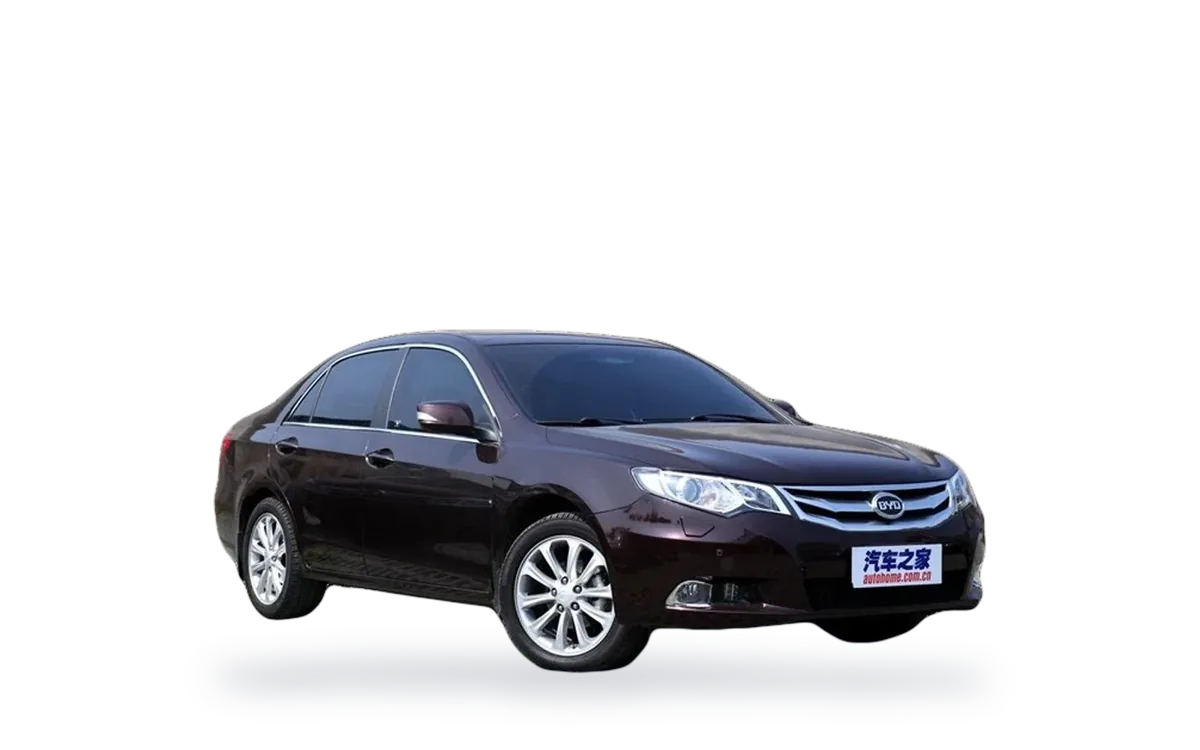
The BYD SiRui is a mid-size, front-wheel-drive saloon that BYD put on sale in April 2013 as a restyled, better-equipped relative of the BYD G6. It is 4,870 mm long on a 2,755 mm wheelbase. A 1.5-litre turbocharged petrol engine with 113 kW and 240 N·m drives the front wheels through either a six-speed manual or a six-speed dry dual-clutch gearbox. For parts, that makes it a conventional petrol car with the usual oil, filters, clutch and exhaust-side sensors. It sits on double-wishbone front suspension, which uses more arms and bushes than a strut-type car. The engine and gearbox hardware is shared with the G6, but the body panels, lamps and much of the cabin equipment belong to the SiRui alone. Every part on this page is listed by its OE number, and matching the number on the old part is the surest way to confirm a fit.
What to know before buying BYD SiRui parts
Start with the name, because two BYD saloons sound alike. The SiRui is the larger car, 4,870 mm long on a 2,755 mm wheelbase. The Surui, sold in some markets as the F3 Plus, is a smaller saloon of about 4,680 mm on a 2,660 mm wheelbase. Some Surui cars used the same 1.5-litre turbo engine and dual-clutch gearbox, but the body and chassis are different, so those parts do not cross between the two. The badge on the boot lid, or a tape measure between the wheel centres, settles it.
The closer relative is the BYD G6. The SiRui was built as a more upmarket G6 with its own styling, and the two are almost the same size: the G6 is 4,860 mm long on a 2,745 mm wheelbase. Engine and gearbox parts are the most likely to be common to both, since both cars use the 1.5-litre turbo with the dual-clutch gearbox. The bumpers, grille, lamps, bonnet and trim are styled differently, so do not order them from G6 listings. For parts the two cars might share, check that the OE number on the listing matches the old part rather than assuming a G6 part will fit.
Next, confirm the gearbox on the car itself. The SiRui was sold with a six-speed manual or a six-speed dry dual-clutch gearbox, and that choice affects more than the gearbox. Dual-clutch cars have an electronic parking brake, so the rear calipers and parking brake hardware depend on which gearbox is fitted. The clutch, flywheel and gearbox control parts also differ between the two. Look at the gear selector before ordering any of them.
Equipment varies more by trim than on most saloons of its age. The infrared night-vision camera, the 360-degree camera set, full LED headlamps and the front side airbags were fitted to some trims and not others. Two cars that look the same can therefore need different lamps, cameras or airbag modules. Check what is actually fitted before ordering, and order by the OE number on the old part. The road tyres are 215/50 R17 and the spare is a smaller 205/60 R16, so read the sidewall of the tyre you are replacing.
There was no facelift. The SiRui was sold as a single 2013 model year, so lamps, bumpers and glass do not change with the build date. Once you know the car is a SiRui, which gearbox it has and what equipment is fitted, the OE number on the old part confirms the rest.
Before You Order: 7 Checks
- Confirm the car is a SiRui and not the smaller Surui. The SiRui's wheelbase is 2,755 mm and the Surui's is 2,660 mm, so measure between the wheel centres if in doubt.
- Match the OE number on the part you are replacing to the OE number on the listing before you order.
- Check whether the car has the manual or the dual-clutch gearbox, since the parking brake, rear calipers and clutch parts depend on it. Look at the gear selector first.
- Treat G6 listings with care. Engine and gearbox parts may match, but body panels, lamps and trim are styled differently, so match every part by OE number.
- Check whether the car has night vision, 360-degree cameras, LED headlamps and side airbags before ordering any of them, since only some trims had them.
- Read the size on the tyre sidewall before ordering. The road tyres are 215/50 R17 and the spare is 205/60 R16.
- Order painted panels by the colour code on the car rather than by colour name.
Generations and Facelifts
The SiRui grew out of the BYD G6, a mid-size saloon launched in China on 26 September 2011 to replace the BYD F6. The G6 offered a 1.5-litre turbo engine with a six-speed dual-clutch gearbox, or a 2.0-litre engine with a five-speed manual. The SiRui took the turbo engine and gave it a restyled, better-equipped body.
The SiRui was first shown at the Guangzhou motor show in November 2012 and went on sale at Auto Shanghai in April 2013. BYD launched it as its new flagship saloon. It had double-wishbone front suspension and a 10.2-inch touchscreen, and the upper trims added infrared night vision, 360-degree cameras and a remote-driving function. Every car used the 1.5-litre turbo, with either a six-speed manual or a six-speed dry dual-clutch gearbox.
The SiRui never had a facelift. It stayed in the 2013 model year throughout its short production run, so there are no early and late versions to tell apart. Lamps, bumpers, glass and interior trim are the same whatever the build date. The G6 did change, with a major facelift in October 2014, which makes G6 body parts from either side of that date even less likely to suit a SiRui.
The name that causes confusion is the Surui, launched in April 2012 as the second-generation BYD F3 and also sold as the F3 Plus. It is a smaller car on a 2,660 mm wheelbase, and its body is its own. From 2014 some Surui cars used the same turbo engine and dual-clutch gearbox, so check the badge before ordering engine or gearbox parts, then match each part by OE number.
BYD SiRui Parts: Frequently Asked Questions
How do I make sure a part fits my BYD SiRui?
Match the OE number. Every part on this site is listed under the OE number printed on the original part, and if the number on the part you are replacing matches the listing, the part fits. This matters on the SiRui because it shares mechanical parts with the G6 but not its styling, and because equipment varies widely between trims. If the old part is missing or its number cannot be read, send a photo through the quote form and we will reply within 24 hours, usually sooner.
Is the SiRui the same car as the Surui?
No, although the names are easy to confuse. The Surui is the second-generation BYD F3, launched in April 2012 and sold in some markets as the F3 Plus. It is a smaller saloon, about 4,680 mm long on a 2,660 mm wheelbase, where the SiRui is 4,870 mm long on a 2,755 mm wheelbase. Some Surui cars used the same 1.5-litre turbo and dual-clutch gearbox, but the body and chassis are different. Check the boot badge and the wheelbase, then order by OE number.
Can I use BYD G6 parts on a SiRui?
Some, but do not assume they fit. The SiRui was built as a more upmarket version of the G6 with its own styling. The two cars are almost the same size: 4,870 mm long against 4,860 mm, with wheelbases of 2,755 mm and 2,745 mm. The 1.5-litre turbo engine and the dual-clutch gearbox are the parts most likely to be shared. Bumpers, grille, lamps and trim are styled differently. Compare the OE number on the old part with the listing before using any G6 part.
Which gearbox does my SiRui have, and why does it matter?
Look at the gear selector. The SiRui came with either a six-speed manual or a six-speed dry dual-clutch gearbox. The clutch, flywheel and gearbox control parts are different for each. The gearbox also decides the parking brake: dual-clutch cars have an electronic parking brake with actuators on the rear calipers, and manual cars have a hand lever. Confirm the gearbox before ordering clutch, gearbox or rear brake parts, then match each part by OE number.
Does the SiRui have an electronic parking brake?
Dual-clutch cars do. The electronic parking brake works through the rear calipers, so a replacement caliper has to suit the parking brake as well as the disc. A manual SiRui has a conventional hand lever and cable, and its rear calipers are different. If the parking brake warning comes on or a rear brake will not release, check the actuator and its connector before replacing the whole caliper. Then order the part for the correct side by OE number.
What suspension does the SiRui use?
It has double wishbones at the front. Each front corner has an upper and a lower arm, and each arm has its own bushes and ball joint, so there are more rubber and joint parts to wear than on a strut-type car. If the car pulls, wanders or wears the inside edge of a tyre, check the arm bushes and ball joints before replacing the dampers. Then order the worn parts by side and by the OE number on the old parts.
Which SiRui has night vision?
Only the upper trims had night vision. The system uses an infrared camera at the front of the car and shows the picture on a display inside. Lower trims were built without the camera, its wiring or the display. Before ordering any part of the system, check that the car actually has it. If it does, order the camera by the OE number on the old unit. If the display went blank after a front-end knock, inspect the wiring as well.
Why does equipment differ between SiRuis that look the same?
The SiRui was sold in several trims with very different equipment. Upper trims added features such as full LED headlamps, 360-degree cameras, night vision and front side airbags. Lower trims had simpler lamps and fewer airbags. Two cars in the same colour can therefore need different lamps, cameras or airbag modules. Check what is fitted to the car you are working on, and order each part by the OE number on the old one rather than by trim name.
What tyre sizes does the SiRui use?
The road tyres are 215/50 R17 on all four corners. The spare wheel carries a smaller 205/60 R16 tyre, so a sixteen-inch tyre in the boot is normal and does not mean the wrong wheels have been fitted. The spare is a different size from the road tyres, so use it only until the damaged tyre is replaced. Read the size on the sidewall of the tyre you are replacing, and match rims by OE number.
Was there a facelift, and does the build year change the parts?
No. The SiRui went on sale in April 2013 and stayed in the 2013 model year for its whole production run, with no facelift and no mid-life change to the body. Lamps, bumpers, grille and glass are the same on an early car and a late one. On this car the parts depend on the gearbox and the trim, not the date. Confirm both, then match each part by the OE number on the old one.
Does the SiRui need regular engine servicing parts?
Yes. It is a conventional petrol car. The 1.5-litre turbocharged engine produces 113 kW and 240 N·m and needs engine oil, an oil filter, an air filter and spark plugs at normal service intervals. The turbo adds boost hoses and intercooler pipework, which can split or leak with age. After an engine warning light, the lambda sensors are among the first things to check. Order service parts by the OE number on the parts you remove.
What should I check after a minor front or rear knock?
Check the sensors, cameras and their brackets as well as the panel. SiRuis were sold with front and rear parking sensors and a reversing camera, and upper trims added 360-degree cameras and night vision. A bumper repair can therefore involve sensors, brackets and wiring as well as the bumper itself. Check each sensor and camera after the repair. Order replacements by the OE number on the old unit, and order painted panels by the colour code.